
Bathroom Disinfectant Wipes, The Canadian Buyer’s Complete Guide

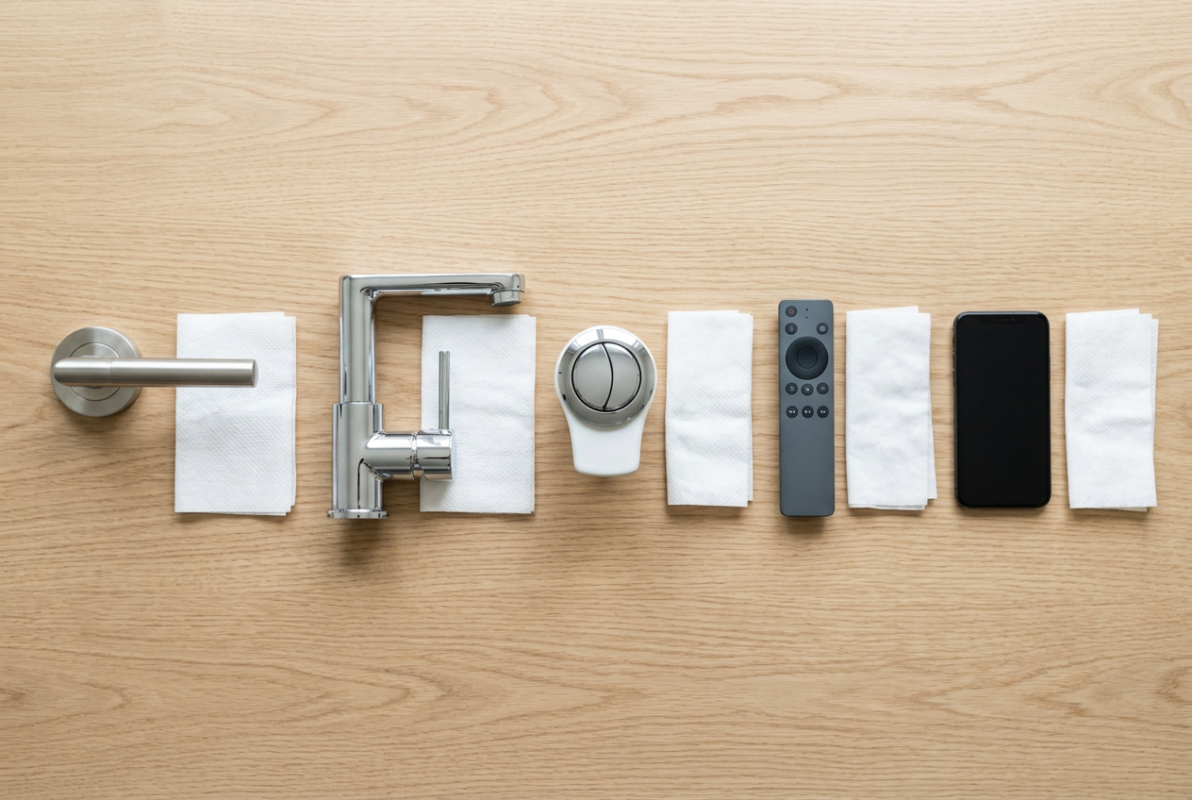
The bathroom is the room in a Canadian home where disinfecting wipes earn their place most clearly and the room where most people’s actual cleaning routine falls shortest of what the hygiene situation actually requires. The toilet flush handle is one of the most contaminated surfaces in any home; it is also the surface cleaned last and least often. The faucet tap is touched with dirty hands before every handwash, making it a consistent contamination point regardless of how well everything else is cleaned. The underside of the toilet seat collects aerosol droplets from every flush and is almost never wiped.
This guide covers the complete picture: which surfaces in a Canadian bathroom are the highest disinfecting priority and why, the correct cleaning sequence that prevents cross-contamination between surfaces, the toilet exterior protocol that most cleaning guides skip past, how contact time works in a bathroom environment, why formula choice matters specifically for enclosed daily-use spaces, and a sustainable routine that actually gets maintained rather than abandoned after the first week.
Why the Bathroom Is the Highest-Priority Disinfecting Zone
The bathroom combines two conditions that make surface hygiene particularly important: high-frequency human contact on a small number of surfaces, and the presence of fecal bacteria introduced into the environment with every toilet flush. Research on fecal aerosol dispersion confirms that toilet flushing with the lid open disperses microscopic droplets containing bacteria across a radius that reaches faucet taps, countertops, and toothbrush holders surfaces that subsequently contact hands, faces, and the objects people put in their mouths.
This is not a reason to be alarmed about using a bathroom it is the reason the flush handle, the tap, and the toilet exterior are the surfaces that matter most in a bathroom disinfecting routine. The contamination pattern is predictable, the surfaces involved are hard and non-porous, and a registered disinfecting wipe used consistently on the right surfaces addresses the actual transmission risk effectively.
The frequency gap in most Canadian households is not about choosing the wrong product it is about not knowing which surfaces need daily attention and which can wait for a weekly clean. The surface priority table below maps this out clearly.
Bathroom Surface Priority Map
Not all bathroom surfaces carry equal contamination risk, and not all need daily disinfecting. Here is the complete surface reference with priority, recommended frequency, and the most-missed cleaning detail for each:
Surface | Germ priority | Frequency | Most-missed detail |
|---|---|---|---|
Toilet flush handle | HIGHEST | Daily | The single most contaminated surface in the bathroom wiped last and least |
Toilet seat (top and underside) | HIGH | Daily | The underside of the seat collects aerosol droplets and is rarely wiped |
Toilet seat hinges and bolts | HIGH | Weekly | Grime and bacteria accumulate in the hinge recesses wipe folded to a point |
Toilet lid (top and underside) | HIGH | Daily | The underside of the lid is aerosolized every flush almost never wiped |
Toilet tank exterior | MODERATE | Weekly | Touched when adjusting mechanism; dusty surfaces trap bacteria |
Toilet base | MODERATE | Weekly | Floor-level grime accumulates around the base join often missed entirely |
Faucet handles / tap | HIGHEST | Daily | Touched with dirty hands before washing the classic pre-handwash contamination point |
Sink basin exterior (sides, drain surround) | HIGH | Daily | Splashing distributes contamination across the basin exterior regularly |
Bathroom counter / vanity top | MODERATE | Every 2-3 days | Toothbrush holders, soap dispensers, and beauty products all sit here |
Light switch | HIGH | Every 2-3 days | Touched every visit, pre- and post-handwash frequently overlooked in bathroom cleaning |
Door handle (interior and exterior) | HIGH | Every 2-3 days | Both sides touched every bathroom visit; rarely included in bathroom cleaning |
Shower/tub exterior taps and handle | MODERATE | Weekly | Chrome fittings tolerate wipes well; wipe around base where grime accumulates |
Towel rail / ring | LOW-MOD | Weekly | Touched with damp hands; lower priority but worth including in weekly wipe |
Daily surfaces require approximately 3–4 wipes per bathroom visit (flush handle, seat top/underside, lid top/underside, tap handles, sink basin). Using a fresh wipe section or a new wipe when moving between the toilet zone and the sink zone prevents cross-contamination.
The Complete Toilet Exterior Sequence
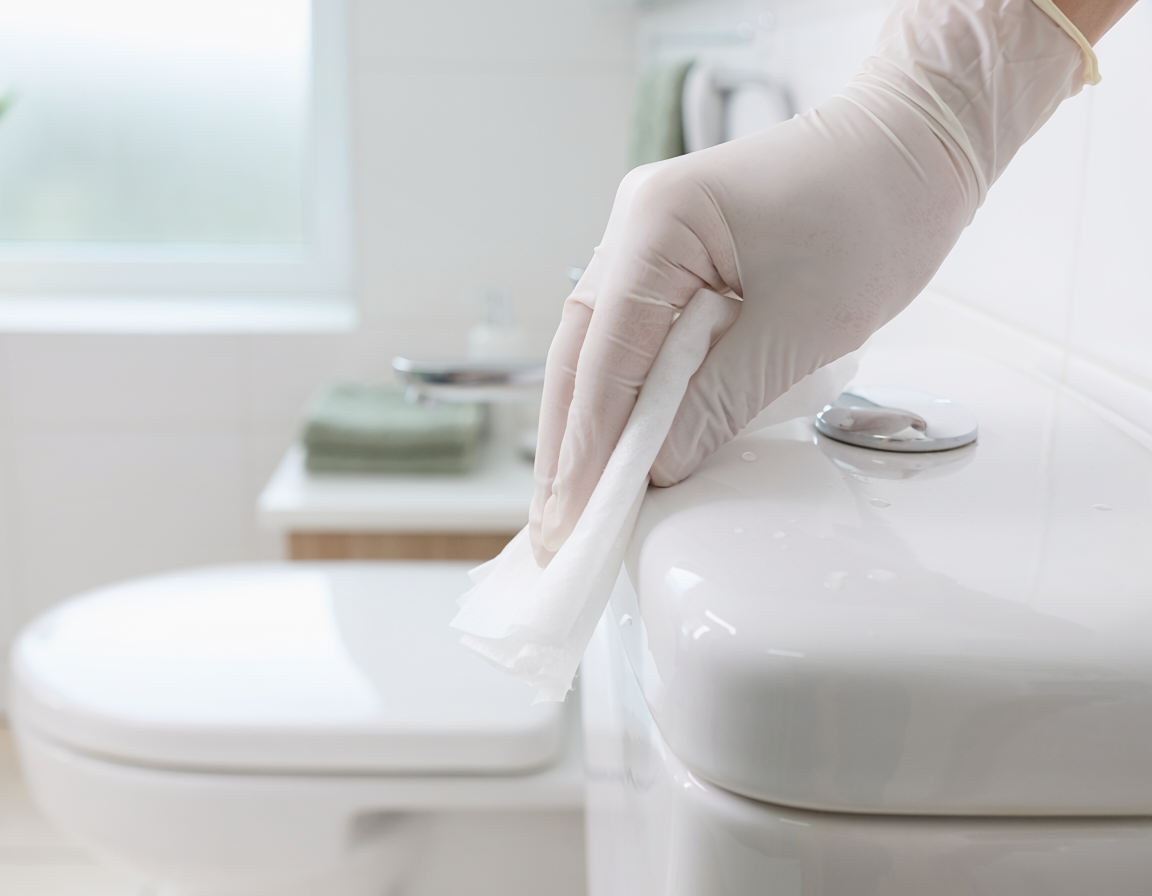
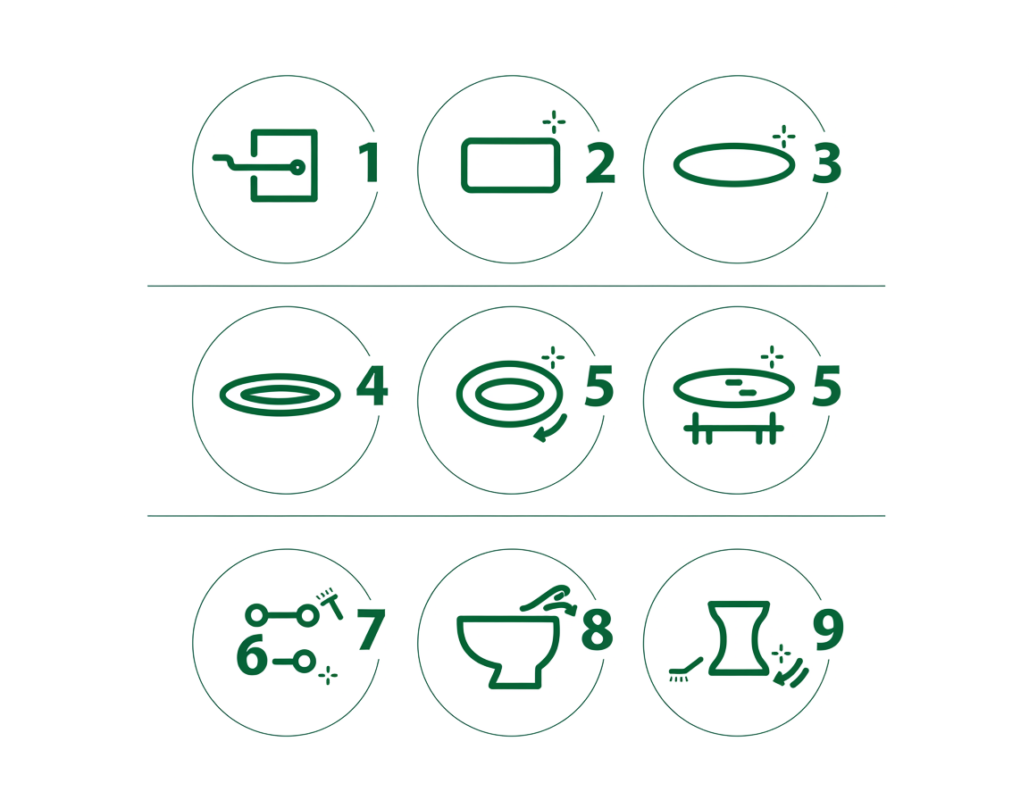
The toilet is the focal point of bathroom disinfection and also the surface where the most gaps appear in real cleaning routines. A complete toilet exterior wipe-down covers more than most people include, and the sequence matters for cross-contamination reasons: always clean from least contaminated to most contaminated, and use a separate wipe for the toilet from the one used on the sink and counter.
- Flush handle Start here or wipe it last with a fresh wipe. This is the highest-priority surface on the toilet and should never share a wipe with any other surface. Wipe the entire handle surface including the underside of the flush lever if present.
- Tank exterior (sides and back) The tank is touched less often but accumulates dust that traps bacteria. Wipe the top, sides, and back of the tank the back is the surface most consistently missed in household cleaning.
- Lid top Wipe the full outer surface of the lid including the edges. Hands contact the lid edges when lifting and lowering.
- Lid underside This surface faces the bowl during flush aerosol dispersion and is rarely wiped. Fold the wipe to access the underside fully.
- Seat top Full surface contact including edges and the area around the hinges where the seat meets the bowl.
- Seat underside Receives aerosol from flushing with seat up. Use a fresh section of wipe or a second wipe for this surface specifically.
- Hinge area and bolts Fold the wipe to access the recesses around the seat hinges and bolts. Grime accumulates here consistently and is almost never reached by a flat wipe pass.
- Bowl exterior (outside, front, and sides) The exterior of the bowl below the seat contact area collects splatter and dust at the base join. Wipe the full exterior down to the base.
- Base The floor-level base of the toilet accumulates grime at the join with the floor, and is the surface most consistently missed in household cleaning. Wipe around the entire base perimeter.
The full sequence uses two to three wipes: one for the flush handle alone, one for the lid and seat (top and underside), and one for the exterior and base. Never use the same wipe from the toilet on any other bathroom surface.
Contact Time in a Bathroom Environment
Contact time the duration a surface must stay visibly wet for a wipe’s kill claim to be met behaves differently in a bathroom than in a kitchen or open living space. Bathrooms are typically smaller, less ventilated, and more humid than other rooms in a Canadian home. High humidity slows surface drying, which in practice means the contact time is more reliably achieved on bathroom surfaces than on kitchen counters in a well-ventilated room.
This is one of the reasons bathroom disinfection with a wipe tends to work well in real household conditions: the formula stays wet on the surface for longer, giving the active ingredient more time to work. The practical implication is that you are less likely to experience the fast-evaporation contact-time problem on bathroom surfaces than on kitchen surfaces particularly with an alcohol-free formula that evaporates more slowly than alcohol-based products to begin with.
Where contact time does need attention in the bathroom is in a well-ventilated bathroom with a running exhaust fan and low ambient humidity particularly in dry Canadian winters when indoor humidity drops significantly. In this environment, wiping and immediately leaving the room means the surface may dry before the contact time is met. The straightforward solution: wipe, leave the surface wet, and come back for the second surface in the sequence rather than rushing immediately to the next one.
Why Alcohol-Free Is the Better Formula for Bathroom Use
The bathroom is a specific environment that makes alcohol-free formula choice more advantageous than in other rooms:
- Enclosed space vapour accumulation The bathroom is typically the smallest and least-ventilated room in a Canadian home. Alcohol-based wipes release ethanol or isopropanol vapour as they evaporate, and in a small enclosed space this vapour concentrates quickly. For anyone with respiratory sensitivity, asthma, or migraines, this concentrated alcohol smell in a bathroom cleaned daily is a genuine daily irritant. An alcohol-free formula is odour-neutral in a way that matters specifically in a confined bathroom environment.
- Daily high-frequency use Bathroom surfaces are wiped more frequently than almost any other surface in the home. A formula gentle enough for daily repeated use without degrading chrome, grout sealant, or plastic surfaces is more appropriate for this use case than an aggressive formula designed for occasional industrial-strength disinfection.
- Chrome and fitting compatibility Bathroom taps, towel rails, and shower fittings are typically chrome-plated or brushed metal. High-alcohol formulas can dull chrome finishes over time with repeated daily contact. Alcohol-free formulas are gentler on these finishes, which matters in a bathroom where the same fittings are wiped every day.
- No fire risk near candles or electrical fittings Bathroom environments sometimes include candles, and the proximity of electrical fittings (exhaust fans, light switches) makes the flammability of high-alcohol formulas a consideration, however minor, for everyday bathroom use.
The ‘24-Hour Bacteria Prevention’ Claim What It Actually Means
Some disinfecting wipe brands, including Clorox, make a “24-hour bacteria growth prevention” claim on their bathroom products. This is worth understanding accurately because it creates an expectation about how long a surface stays protected after cleaning that does not match how most people use their bathroom.
The 24-hour claim refers to the ability of residual active ingredient to inhibit the re-growth of bacteria on the treated surface for up to 24 hours after the product has dried it does not mean the surface is protected from new contamination introduced from outside. A toilet flush handle disinfected at 8am is not protected against recontamination from the next person who uses the toilet at 8:15am without washing their hands. The 24-hour protection applies to bacterial regrowth from residual organisms, not from new external contamination events.
The practical meaning: the claim supports less-frequent disinfecting on low-traffic surfaces. It does not support less-frequent disinfecting on high-touch surfaces like flush handles and tap handles, where new contamination is introduced with every use. Daily disinfecting of high-touch bathroom surfaces is still the correct approach regardless of whether the product carries a 24-hour claim.
A Sustainable Canadian Bathroom Disinfecting Routine
The most effective routine is the one that gets maintained. This breakdown is designed around what is practical in a busy Canadian household rather than what is technically thorough in every possible way:
- Daily (takes approximately 2 minutes) Flush handle, toilet seat top and underside, toilet lid top and underside, faucet tap handles, sink basin exterior. Use three wipes: one for the flush handle alone, one for the seat and lid, one for the sink area. This covers the highest-priority surfaces at the frequency they need.
- Every 2–3 days Light switch, door handles (both sides), bathroom counter and vanity top, soap dispenser exterior. These surfaces accumulate contamination but at a lower rate than daily surfaces.
- Weekly Full toilet exterior sequence (all nine steps above), tank back, hinge and bolt area, toilet base, shower and tub exterior taps, towel rail, floor around toilet base. This is the thorough pass that catches the surfaces daily wiping misses.
- During illness Increase daily surfaces to twice daily morning and evening for the full duration of active symptoms. Focus particularly on any surface the ill person touches between bathroom visits, including the door handle and light switch every time.
How Many Wipes Does a Canadian Bathroom Routine Use?
A practical estimate helps with purchasing decisions. For a household following the routine above:
Daily: 3 wipes per bathroom, per day. A household with one main bathroom and one guest bathroom used daily uses approximately 6 wipes per day on the daily routine alone.
Weekly addition: approximately 8–10 wipes per bathroom for the full weekly sequence. For two bathrooms, 16–20 additional wipes per week.
Monthly total for two bathrooms: approximately 200–240 wipes roughly one 80-count canister per bathroom per month, or two to three canisters per month across a typical Canadian household.
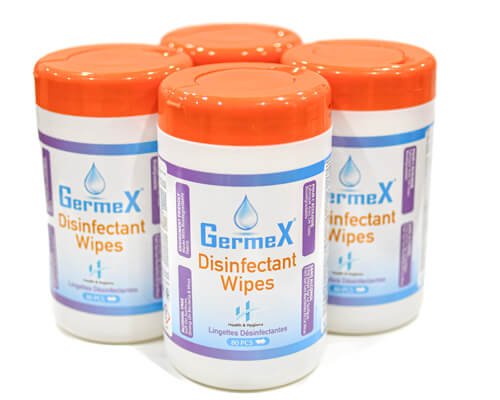
The GermeX 4-canister pack (320 wipes total) covers approximately six to eight weeks of a two-bathroom household routine, making it a practical supply format for ongoing bathroom use rather than a one-time purchase. Order directly from the GermeX 4-canister pack page, or browse all available formats in the disinfecting wipes collection.
Frequently Asked Questions
Can I use the same wipe on the toilet and the sink?
No. The toilet particularly the flush handle, seat, and exterior is the highest-contamination surface in the bathroom. Using the same wipe on the toilet and then the sink transfers toilet bacteria to a surface used for handwashing and face care. Always use a separate wipe for the toilet zone and the sink zone.
Should I clean before I disinfect in the bathroom?
For most bathroom surfaces in a standard household, a disinfecting wipe handles both cleaning and disinfecting in a single pass on a moderately clean surface. For surfaces with visible buildup heavy limescale on taps, soap residue on the basin a basic clean first (wet cloth or paper towel) removes the buildup that would otherwise prevent the wipe’s active ingredient from reaching the surface beneath.
Are disinfecting wipes safe on chrome taps and fittings?
Yes, with an alcohol-free formula preferred for daily use. Alcohol-based formulas can dull chrome finishes over time with repeated daily contact. An alcohol-free, registered disinfecting wipe is safe for chrome, ceramic, and plastic bathroom fittings with everyday use.
Do I need to rinse bathroom surfaces after using a disinfecting wipe?
For bathroom surfaces toilet, sink, counter, light switch that do not contact food directly, no rinse step is required. A rinse step is only relevant for food-contact surfaces in kitchens where residue may reach food. Bathroom surfaces do not require rinsing after disinfecting wipe use.
How many wipes do I need for a complete bathroom clean?
For a daily routine covering flush handle, seat, lid, tap handles, and sink basin: three wipes. For a full weekly sequence including the complete toilet exterior, counter, light switch, and door handles: seven to ten wipes per bathroom. A household with two bathrooms uses approximately 200–240 wipes per month on a consistent routine.
The bathroom is the highest-priority disinfecting zone in a Canadian home, and a consistent wipe routine on the right surfaces at the right frequency is the single most effective household hygiene action most families can take. The surfaces that matter most flush handle, tap handles, seat underside, sink basin exterior are manageable in under two minutes per day with the right product and a clear surface sequence.
For daily bathroom disinfection, an alcohol-free, Health Canada registered wipe is the practical formula choice: gentler on chrome fittings, no alcohol vapour in an enclosed space, no contact time compromise from fast evaporation, and appropriate for the high-frequency daily use that a bathroom routine actually involves.
Order the GermeX 4-canister pack 320 wipes, Health Canada registered, alcohol-free for six to eight weeks of a two-bathroom household routine, or browse all formats in the disinfecting wipes collection.